
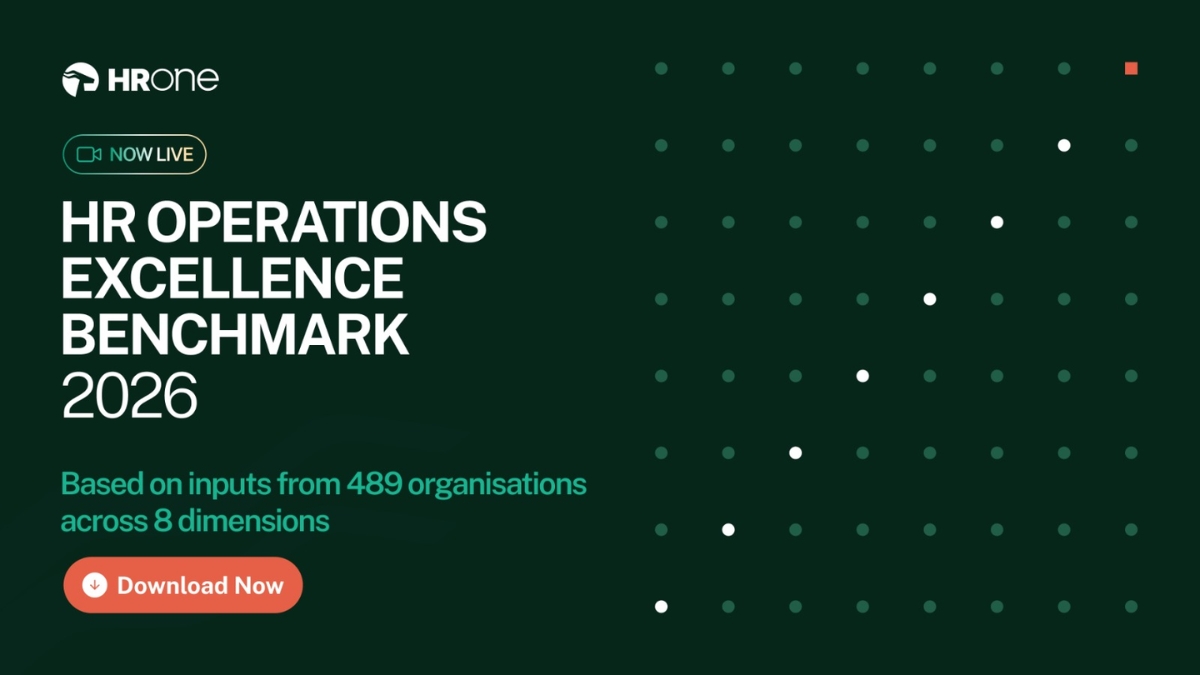
Based on inputs from 489 organisations across 12 industries, the report finds only 11.5% of Indian HR functions reached “Intelligent” maturity in 2026.
Noida (Uttar Pradesh) [India], September 14: HROne, a leading HCM software, today released HR Operations Excellence Benchmark 2026, a nationwide research study revealing a structural gap running through enterprise HR in India: the average HR operations maturity score across the country is 54.6 out of 100, and only 11.5% of organizations qualify as “Intelligent,” the highest tier on the report’s four-stage maturity model.
The report draws insights from 489 unique respondent organizations, spanning 12 industries, including 207 CHROs, CPOs, and HR Heads. The findings show that Indian HR has digitized individual, rules-based transactions with real discipline, but has not redesigned the coordination work that runs between them: approvals, escalations, employee queries, the handoffs that determine whether HR feels fast or slow to the people inside it.
The central message of the report is clear: Indian HR has already won the digitization argument. What remains unresolved is whether the work between the systems moves at the same speed the systems themselves now promise.
Key Findings: The HROne HR Operations Maturity Index 2026
HR Operations Excellence Benchmark 2026 moves beyond a single adoption number to assess structural readiness dimension by dimension. It combines a quantitative benchmark with qualitative context from HR leaders, who shared their perspectives on the findings to ground the numbers in real operating experience.
Key insights include:
- The maturity ceiling of HR operations is lower than most assume
Most HR teams score just 54.6/100 on operational maturity – solidly “Digitized,” one step short of “Automated.” Only 1 in 9 organizations (11.5%) has actually made it to “Intelligent.”
- Strength in one area of HR services masks weakness in another
Payroll runs like clockwork (77.8/100), but employee service delivery lags badly (41.8/100) – a 36-point swing. The same HR function can be excellent and stuck at the same time. - Chasing people down has become HR’s job
64.6% of HR teams manually chase work at least once a week just to keep things
moving. It’s no surprise 60.3% call manual follow-ups and approvals their #1 operational headache.
- Reporting hasn’t caught up to what’s actually wanted by HRs
62.8% of organizations still report monthly, or don’t report at all. Yet 42.1% say analytics and dashboards are their top priority this year – the tools simply haven’t kept pace.
- HR-IT alignment is the biggest lever nobody’s pulling
Maturity nearly doubles from 36.6 to 74.9 when HR and IT jointly own data, adoption, and governance. Only 9% of organizations have gotten there.
The report introduces the HROne HR Operations Maturity Index 2026, a benchmark framework that scores every organization across eight operational dimensions — payroll reliability, employee service delivery, attendance and workforce visibility, compliance readiness, workflow discipline, reporting and decision visibility, HR-IT enablement and governance, and AI readiness and adoption and combines them into a single score placed on a four-stage model: Manual (0–30), Digitized (31–55), Automated (56–75) and Intelligent (76–100). A free, public version of the index is available now as a self-assessment tool, letting any organization see exactly where it stands in about 20 seconds.
Implications for Priorities of HR Leadership
HR’s operational maturity is no longer a back-office question. It shapes how fast a company hires, how reliably it pays people, how quickly an employee query gets resolved, and how much of a leadership team’s week is spent firefighting instead of deciding. The benchmark shows that in most Indian organizations, the systems are already in place — the coordination discipline to run them well is not.
“Buying software for every HR process was never the same thing as making those processes move faster together. This benchmark exists so that HR leaders can see exactly where their own organization sits before they decide what to fix next,” says Karan Jain, Founder, HROne.
Independent voices in the HR profession echo the same concern. “Indian HR has spent two decades proving it can run payroll and attendance without error. That was never the hard part. The hard part and the part this benchmark finally put a number on is whether the work between those systems moves with any discipline at all,“ says Dr. T.V. Rao, widely regarded as the Father of HRD in India, Founder of the National HRD Network and TVRLS.
The research emphasizes that the real competitive advantage in HR operations no longer lies in adopting more point solutions; it lies in closing the coordination gap between the ones already in place.
Implications for India’s Business Ecosystem
India’s scale, its pace of hiring, and the regulatory complexity HR teams operate under create conditions where digitization happens fast, often out of sheer operational necessity while the discipline to coordinate across systems lags behind.
The report argues that an unresolved coordination gap introduces risk that compounds as companies scale:
- Slower hiring and onboarding cycles when approvals depend on manual chasing rather than defined workflow
- Compliance exposure when follow-up, not process design, is the only safety net for statutory deadlines
- Elevated attrition risk in the dimension the data shows is weakest nationally — employee service delivery
- Leadership decisions made on monthly or unavailable reporting, in a market that moves week to week
In a market where operational discipline increasingly shapes enterprise valuation and employer brand, HR coordination maturity becomes a board-level conversation — not merely a functional one.
HROne’s Commitment to Closing India’s HR Operations Gap
The launch of this benchmark reflects HROne’s long-standing thesis: that closing India’s HR maturity gap requires not another point solution, but a single coordination layer where approvals, escalations and employee queries move in one place, visible to everyone who needs to see them.
“The most operationally excellent HR teams of tomorrow won’t be the ones with the most software, they’ll be the ones where the work between that software moves without anyone having to chase it. That’s the gap this benchmark measures, and it’s the exact gap HROne was built to close. Every module we ship is judged against one question: does this make the coordination faster, not just the transaction,” says Karan Jain, Founder, HROne.
The study concludes that HR’s strategic relevance over the next decade will depend less on how many processes get digitized and more on how fast the work between them moves. In this next phase, HR will not be judged by how many systems it has deployed. It will be judged by how fast work actually moves between them.
About the Research
The HR Operations Excellence Benchmark 2026 is based on a survey fielded to HR professionals across India. HROne received 510 submissions; after deduplication, 489 unique respondent organizations across 12 industries were retained for analysis, including 207 CHROs, CPOs, and HR Heads. Respondents were scored across the eight dimensions of the HROne HR Operations Maturity Index 2026, which combine into an overall maturity score placed on the four-stage model described above. All data is self-reported by respondent organizations and is presented as an indicative benchmark, not an audit or compliance assessment of any individual organization.
About HROne
HROne is the world’s easiest-to-use, AI-powered HRMS software — built to help HR teams work smarter, faster, and more human.
From hire to retire, HROne automates work across 10+ powerful modules — from recruitment and onboarding, through attendance, leave, payroll, and expense, to performance, engagement, and beyond. The result: HR teams that spend less time chasing tasks and more time driving real impact.
At the heart of HROne is the One AI Suite — home to India’s first voice-enabled, execution-first AI agent. Just say the task, and it’s done. For everything else, InboxForHR brings all tasks across 10+ modules into one screen, so your team clears daily tasks in under an hour and redirects their energy to work that actually moves the needle. And when the workday moves off the desk, the HROne Mobile App puts 110+ HR actions in your people’s pocket — so nothing waits, no matter where the day takes them.
Backed by 2,500+ brands, over a million users, and a 4.8/5 rating on both G2 and Gartner Peer Insights — HROne is a G2 Best Software 2026 winner and Gartner Customers’ Choice 2025 — validation from the industry’s most trusted voices, powered by the people who use it.
If you object to the content of this press release, please notify us at [email protected]. We will respond and rectify the situation within 24 hours.